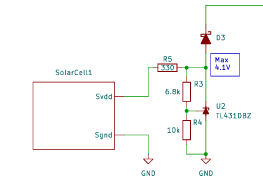
As the solar cell (1”x1”) can deliver no more than 5mA/4V, I intend to do a very simple schematic: one Zener diode to clamp the voltage bellow 4V and one schotky diode to connect to the Vbat of the Xiao board.
Does anybody have tried such stuff, and do you have any comment or see any issue ?
SO it’s a great topic and becoming more mainstream , IMO.
For the Xiao, a couple things.
The Schottky idea is fine, but I would be careful about using only a Zener clamp as the “charger.” With a tiny solar panel, the panel is a high-impedance source, so a simple clamp tends to waste energy and lets the panel operate far from its best point.
The bigger concerns are startup current into the 55 F storage element, poor harvest efficiency in weak light, and brownout behavior around dawn/dusk.
For a quick experiment, diode + current limiting + clamp can work, but for a dependable node I would strongly consider a real energy-harvesting / PMIC solution or at least add current limiting and UVLO.
Also double-check which XIAO pin you feed, because XIAO boards have a charger/power-path IC on the battery input rather than a raw storage node.
Budget for darkness honestly.
Your instinct is right that 55 F is a lot of storage, but whether it covers “a few days” depends entirely on the usable voltage swing and regulator path, not just the farad number.
I have used AHCR’s (40F) in a project and they work really well…
They do require some “extra” energy to charge so provided your solar panel can deliver enough to charge your cap and power your device (averaged) your simple design may work (given 300uA average consumption, and 4V/5mA generation).
I added a low voltage cutoff (2.5V) to protect the cap and used the VBus (not VBat). Alternatively, you could go into Deep Sleep if the cap voltage got too low (say 2.6V).
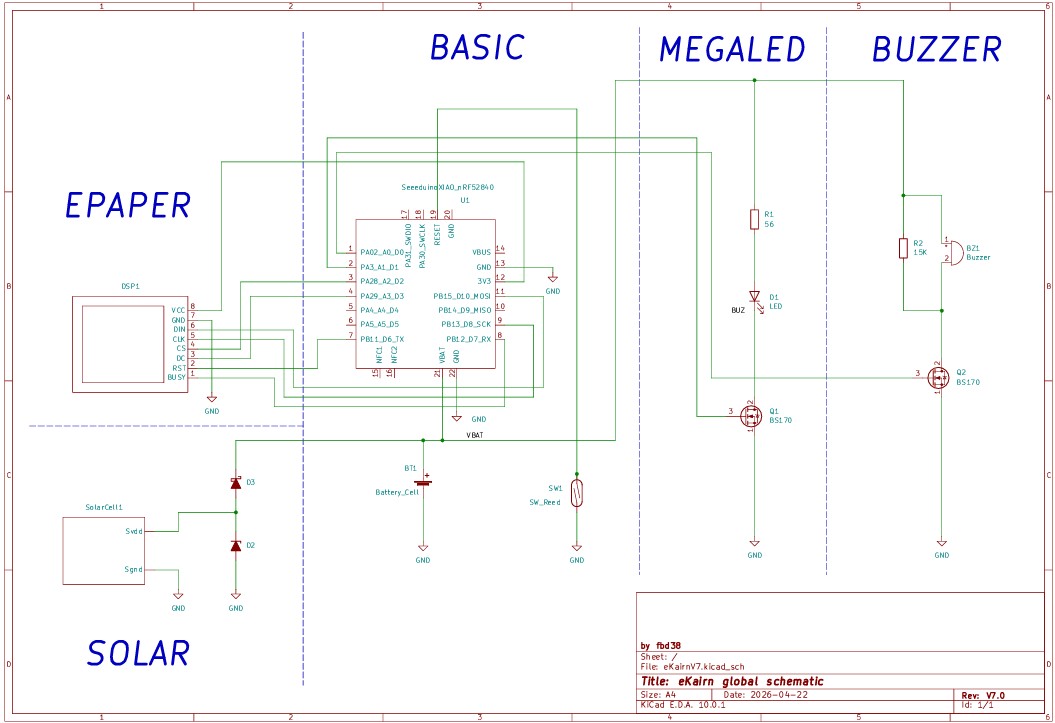
Hi, Thanks for your support, here is the full schematic, it have several options, that I can mount or not according with the final product we will want to do.
For example for the solar solution is must come without ePaper neither MegaLED. Product will ePaper and MegaLED will use regular Lithium 550mAH battery (an no solar cell).
If we consider the solar solution I just need a “good enough” solution, it is not supposed to be optimum (MPPT), the main concern is the price and the size.
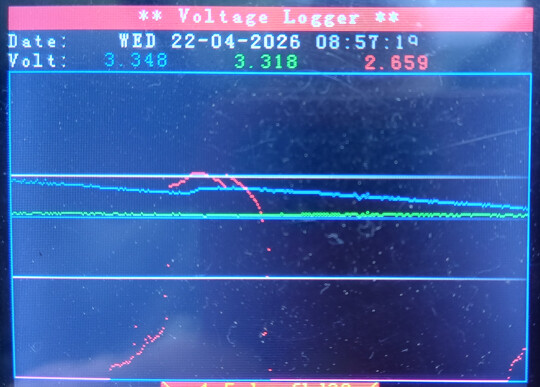
I did a recording of the three voltages: Red: solar cell; Blue Battery; Green 3.3V Vdd; over more than one day partially sunshine. (it is from 2.5V up to 4V, one point every 5 minutes).
I did some basic testing yesterday and the 40F UltraCap stayed charged (NB. It was fully charged initially).
While the solar and zener setup is “non-standard” I didn’t have any issues with testing (I only had a 3V6 zener), but if the solar panel doesn’t ever exceed 4.2V, then the zener is probably unnecessary and may just add extra leakage current.
The Logger was a nice touch.. You can see the SOLAR panel very well.
To hear "ELON " talk about the sun this is right up his alley.
Looks like the “Just good enough” is doable. I like that MegLED
How loud is the Buzzer?
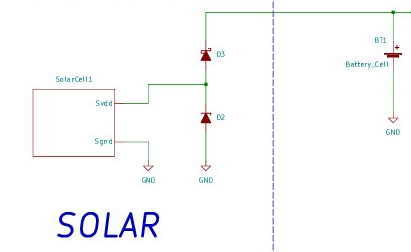
I have modified a bit my schematic, so that i can accommodate different solar cells. I was not knowing this component which seems very common. thanks again for the reference.
Thanks for your support. the HW works quite well, I am now developping the SW. Up to now the full application consume about 100µA when transmitting Beacon and 10µA when OFF. this is perfect for solar application.
Regarding the buzzer, it is not very loud ufortunately, but it is still “just good enough”.
Hello.
What kind of battery did you use with your solar Application ?
I’ve dismantle a solar light, in order to get the solar panel and the battery included, and I am looking for compatibility with standard AA NiMH accumulator and the XIAO nrf52840.
You must first caraterize your solar panel. place it in front of a strong sun and measure the voltage you get (at almost zero current) it gives V0. then measure the current (at almost zero volt) it gives I0.
With these two values I0 and V0 you can derive if it will be possible to supply the board.
Regarding NiMh it is an old technology, and I doubt it is suitable for this board, as you will need to have 3 cells (3*1.4V = 4.2V) while the board is designed for 3.7V.
 concerns are startup current into the 55 F storage element, poor harvest efficiency in weak light, and brownout behavior around dawn/dusk.
 PJ
PJ 
 You can see the SOLAR panel very well.
 I like that MegLED