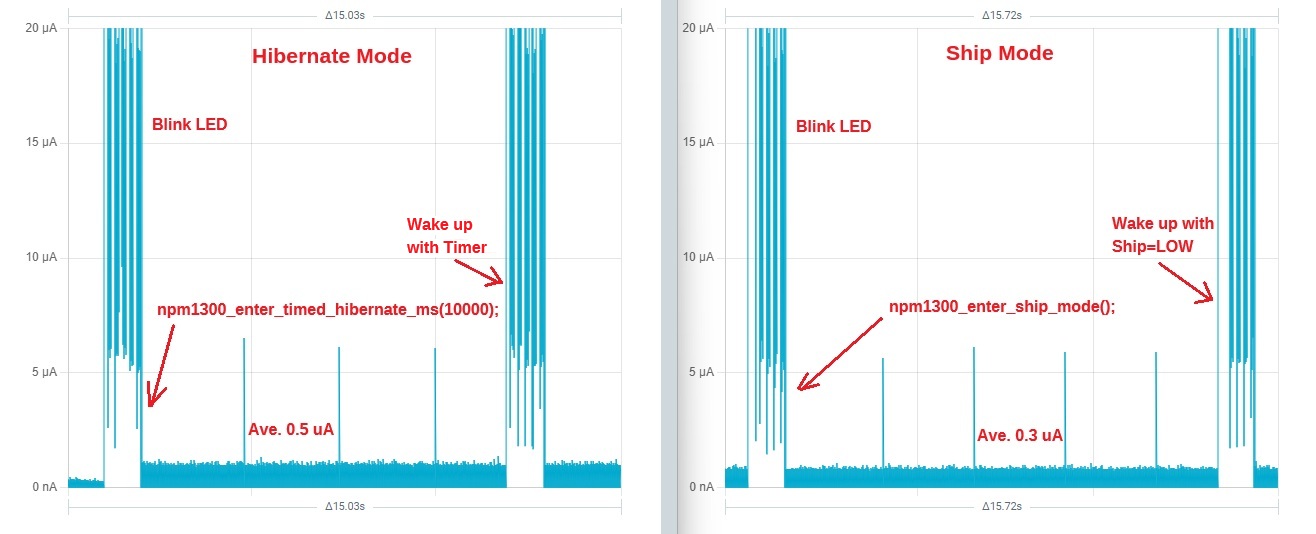
Using the nPM1300 - a key feature of the XIAO nRF54LM20A - I measured the sleep current in Hibernate Mode and Ship Mode. The results were 0.5 uA in Hibernate Mode and 0.3 uA in Ship Mode, both of which are excellent values that match Table 4: System Electrical Specifications in the datasheet.
The experiment used the nrf54-arduino-core v0.9.213 as the BSP, and measurements were taken by applying 3.8 V via ppk2 to the battery pad on the back of the board. Since the nPM1300 allows the charging function to be disabled, it can be used with a button cell battery. Additionally, because the LM20A keeps peak transmit current low, it shows great potential for use in energy-saving projects.
Pre-orders have also started, so I hope this information will be helpful to anyone considering the XIAO nRF54LM20A for their next project.
// BSP : nRF54L15 Boards v0.9.213
// Board : XIAO nRF54LM20A

#include <Arduino.h>
#include “npm1300.h”

void setup() {
pinMode(LED_BUILTIN, OUTPUT);
digitalWrite(LED_BUILTIN, HIGH);

for(int i = 0; i < 5; i++) {
digitalWrite(LED_BUILTIN, LOW);
delay(100);
digitalWrite(LED_BUILTIN, HIGH);
delay(100);
}

// enter Ship mode, Wake up with Ship=LOW
npm1300_enter_ship_mode();                // 0.3 uA

// enter Hibernate mode
//npm1300_enter_timed_hibernate_ms(10000);  // 0.5 uA
}

void loop() {
}
 over the PCB and spinning in a circle 3 times
  , just to read the battery. The ship mode is next level.

 PJ
PJ 