Subject: Recommendation for a compact vibration motor for XIAO nRF52840 Sense (Wearable Posture Corrector)
Body:
Hi everyone,
I am currently developing a wearable neckband project designed to prevent “tech neck” (turtle neck syndrome).
I am using the Seeed XIAO nRF52840 Sense. The logic of the project is to use the board’s built-in IMU sensor to detect the tilt angle of the user’s neck. If the angle exceeds a certain threshold, the device should trigger a vibration alert to correct the user’s posture.
Since this device will be inserted into a neckband and worn for long periods, the vibration motor needs to be very lightweight and compact.
I have a few questions regarding the hardware selection:
Motor Recommendation: Could you recommend a specific vibration motor (preferably a Coin/Pancake type for size) that is compatible with the XIAO nRF52840?
Powering the Motor: Since the GPIO pins have current limitations, do I strictly need a transistor/MOSFET driver circuit to run a small coin motor safely, or are there any low-power motors that can be driven directly? (I want to keep the circuit as small as possible).
Voltage: Since the XIAO operates on 3.3V, should I be looking for a 3V-rated ERM motor?
Any suggestions on parts or circuit diagrams for this specific board would be greatly appreciated!
So check out the vibration motors used in the Parkinson’s gloves .
Similar to what’s in phone and vibrates
12mm on Amazon , cheap too. https://a.co/d/1iUEcxT
HTH
GL PJ
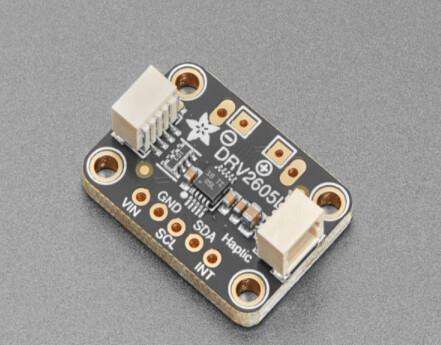
The excellent Texas Instruments DRV2605L includes a library of vibrations and manages both eccentric rotating motor (ERM) and linear resonant actuator (LRA).
So , the specs on those are * Micro Vibration Motor Rated Voltage: DC 3V; Rated Speed: 12000 RPM, If you just need one, Yes add a Series resistor to limit the current from the GPIO pin and try not to use any of the strapping pins (D0-D2),Try A3 or A4.
If you want more finite control do as @reivilo suggest and look into the controller driver.
Also look at some of the others available, the physical shape is also variable Flat (coin) or Cylinder.
Thank you for your reply.
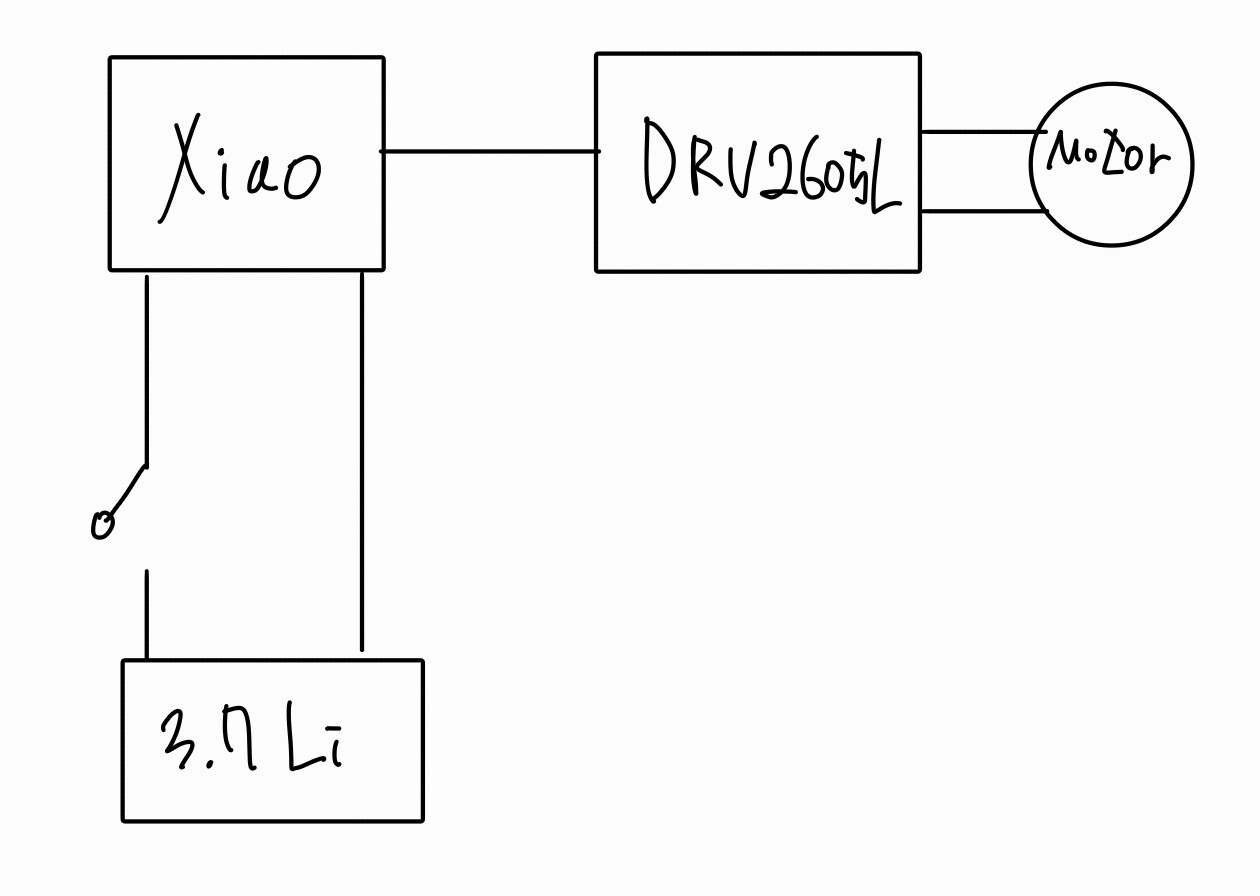
Can the DRV2605L and Seeed XIAO nRF52840 Sense be connected directly without additional circuit components such as other transistors?
The DRV2605L can be connected directly to the Xiao through the I²C bus, with the usual pull-up resistors. The motor, either ERM or LRA, connects directly to the DRV2605L.
I recommend using the Adafuit breakout board, as it includes the resistor, and pick the listed vibrating mini motor.
I don’t see the charging circuit of the LiPo battery on the schematic.
If you plan to use the battery charging chip of the Xiao nRF52840, you can’t use a switch to disconnect the battery.
As most embedded systems operate, the whole circuit is always on but the nRF52840 enters deep sleep. Use a temporary push button connected to an interrupt-capable GPIO as trigger to wake it up.
 PJ
PJ 
 PJ
PJ