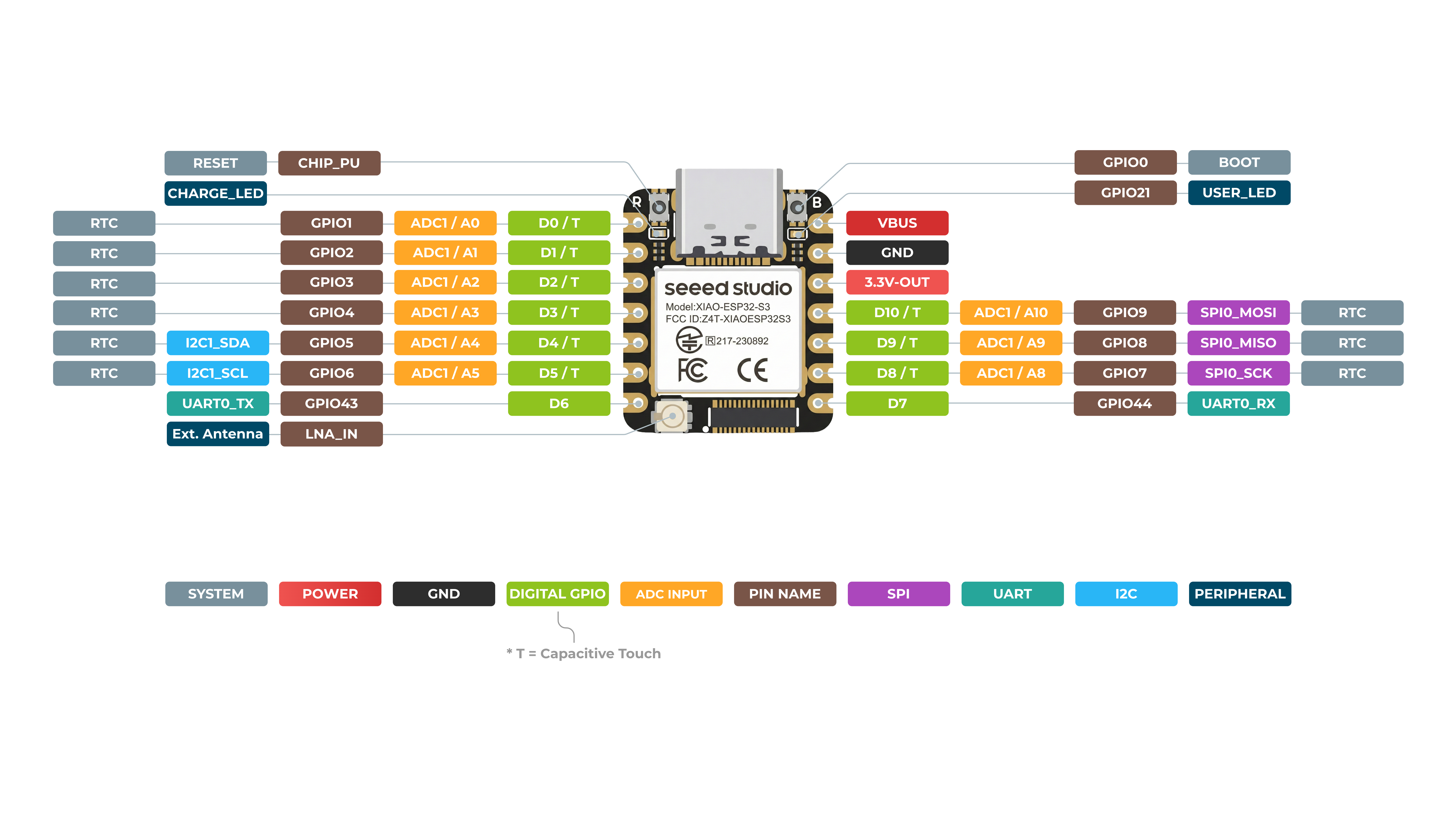
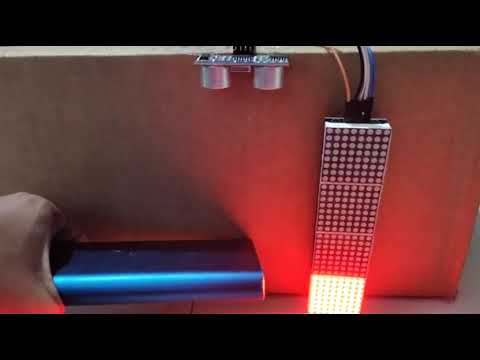
Hydroview is a real-time water level monitoring system designed for household and industrial water tanks. It uses an HC-SR04 ultrasonic sensor to measure the distance from the top of the tank to the water surface, then visually represents the water level on a MAX7219-based 4-in-1 LED matrix module. The system is powered and controlled by an XIAO ESP32S3 Sense development board, ensuring accurate readings and smooth LED updates without flicker.
By mapping the detected water depth to the LED matrix columns, hydroview provides an intuitive bar-graph-style display where more illuminated columns indicate a higher water level. This makes it easy to visually check the tank status at a glance — no need for manual measurements.
Is there any way to connect a sensor like that to a Sensecap solar p1 pro and get it’s results using meshtastic?
I’ve got a water deposit a few hundred meters from my house, and going there to monitor if there is water or not is bothering me more every day. I’ve got no electricity there, so any solution has to be solar and very overdimensioned, as the deposit is at the shade of trees so the water does not get overheated.
I already have a sensecap solar p1 pro node in a place that hast good coverage for both my home and the deposit… and would want to get that information from home.
Developer information is very scarce for the Sensecap solar P1 module. Any guidelines would be greatly appreciated.
I’ve done this and it was simple, however the old meshtastic forum is gone so all the info I posted about it is gone too.
I used a HC-SR04 range sensor connected to a pair of GPIO on a Heltec V3, the most difficulty was in getting the speed correct and setting the serial.mode SIMPLE on the V3.
I still have the code I wrote
The issue I had was errors in reading so I’d get reading like this:
This is basically what I (plan) on doing in our RV, measuring the levels of the waste tanks. Boy, what a (simple!) project this turned out to be.
But after seeing the Seeed mmWave sensors, I want to try and see if I can sense the levels inside the tanks, without cutting holes in them (for the ultrasonic sensors).
So far, I can’t seem to post a question about them.
I’ve been using their XIAO boards for various things (related to this project). But just found the mmWave sensors, and have a few questions.
So, In the FAB in OR. they used different tech at differing times with certain chemicals, some Volatile and some not. I had an opportunity to observe how it interfaced with the SCADA system.
I can say this External Capacitive Strip Arrays (Properly Calibrated) worked but had to be maintained, checked on , everything was redundant so any sign of anything guys got in the field. RAPIDO like..
Continuous capacitive foil strips (like Garnet SeeLevel II systems) stick to the outside exterior wall of the tank.
If capacitive sensors previously failed on certain tanks, it is usually due to wall thickness variation, lack of a proper ground reference plane, or uncalibrated offsets rather than a failure of the tech itself. Using a differential capacitive controller (like the MPR121 or dedicated tank sensor ICs) with a grounded shield trace solves the density/wall thickness issue. They are basically a touch sensor tuned to your tank wall thickness. Some tanks had overlapping strips in parallel.
Do your Tanks have a sight glass or even a cap you could put on in, or replace with a pre-made sight-glass cap?
The later tanks like for Isopropyl alcohol or some other DI tanks had Everything built into a CAP with a TOF sensor in it. THEY just worked , never had to mess with them. Grove makes one here. so I would do that.
The ultra sonic thing is too sensitive to sloshing, we tried it in a AGRO mixing tank and it would be consistent enough to be reliable.
The mmWave radars work but it’s not ideal, mostly because of the head room required in the tank to make a good read on the distance , I have a mmWave measuring demo on here, and with the APP that it supports, you could try but I’m betting only works well if you mount it a very specific way.
The sensor’s dead zone (typically 10–20 cm) and internal reflections from the plastic container will overpower the return echo from the liquid surface.
I think they have this (NOTE :)in the WIki or the Blog about them, YMMV.
(Note: While mmWave radar is exceptional for detecting human body motion, breathing, or solid objects across open air space, it generally struggles with continuous liquid level measurement inside small, tight containers/tanks due to internal wall reflections and narrow dead-zone constraints).
also one is 24 GHZ the other is 60GHZ
Sensor / Module
Operating Frequency
Primary Function
Form Factor / Compatibility
24GHz mmWave for XIAO
24 GHz
Static presence, human motion detection
Direct plug-and-play expansion for XIAO microcontrollers
MR24HPC1 / Lite
24 GHz
Distance detection, target tracking, presence energy
Standalone module with UART for custom MCU / ESPHome
i currently hail from Huntsville, Al. Rocket City! (I used to pilfer parts off the Saturn V rocket outside the Space and Rocket center when I was a kid. Wish I still had them!)
It looks like the mmWave sensors are sort of “pre-programmed” to be useful for me. If I could get down to the nitty-gritty of the chips, it would probably work. But I’m getting too old for that sort of thing, it would probably take more time and $$ than it’s worth. Dang, just “simple sensors” etc… are costing me a fortune.
I think I’m going to take a serious look at the ESP-32 touch sensor. Or perhaps an actual “touch sensor” chip. I saw one a while back that looked pretty good. I’ll have to find it again. Somebody has a breakout board for it. The engineering board was pretty costly. I think the chip was about $11 or so. I’ve got enough of the XCY devices, I can bust one of them open and play with the pretties and see what I can see.


 PJ
PJ