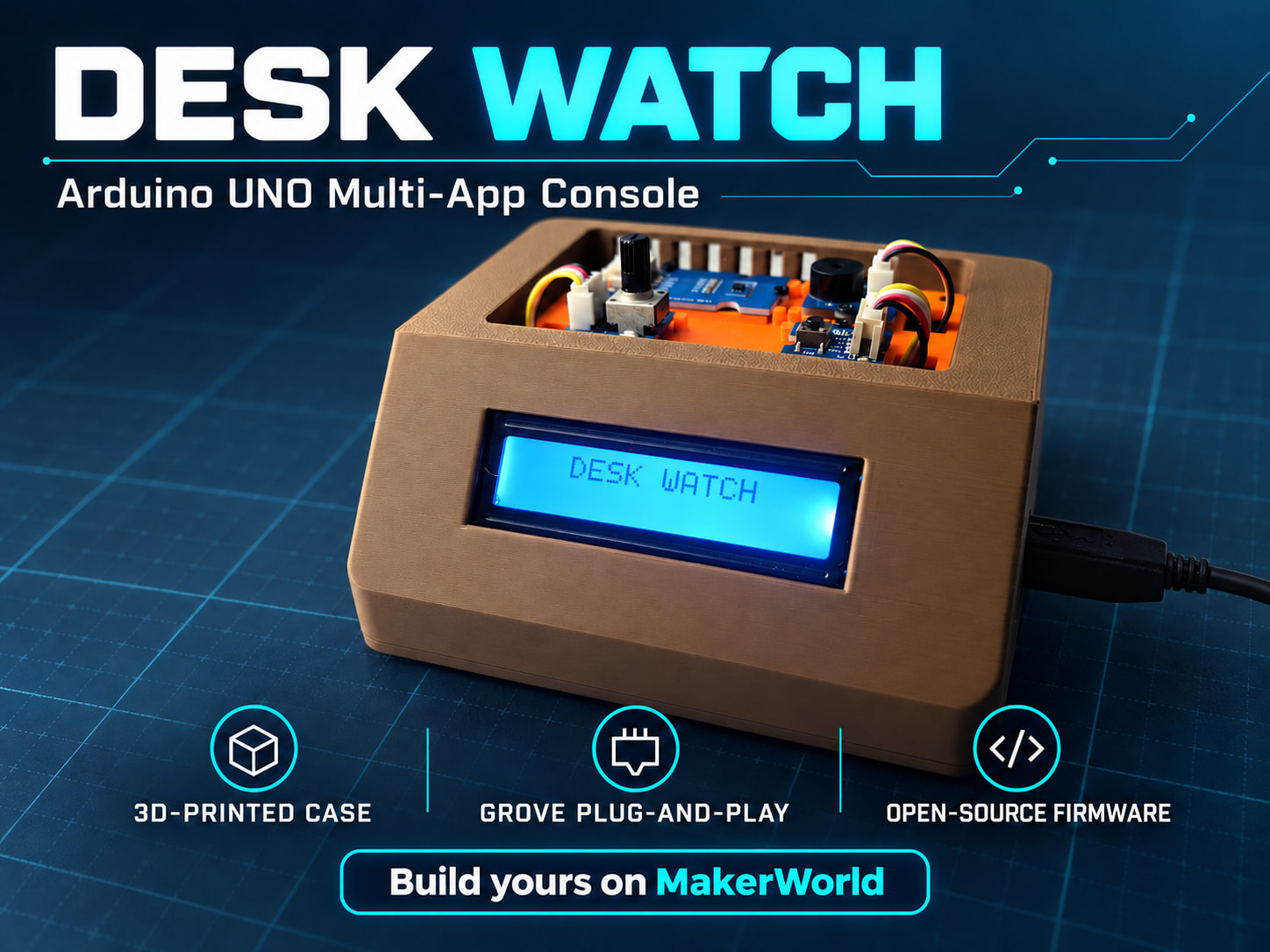
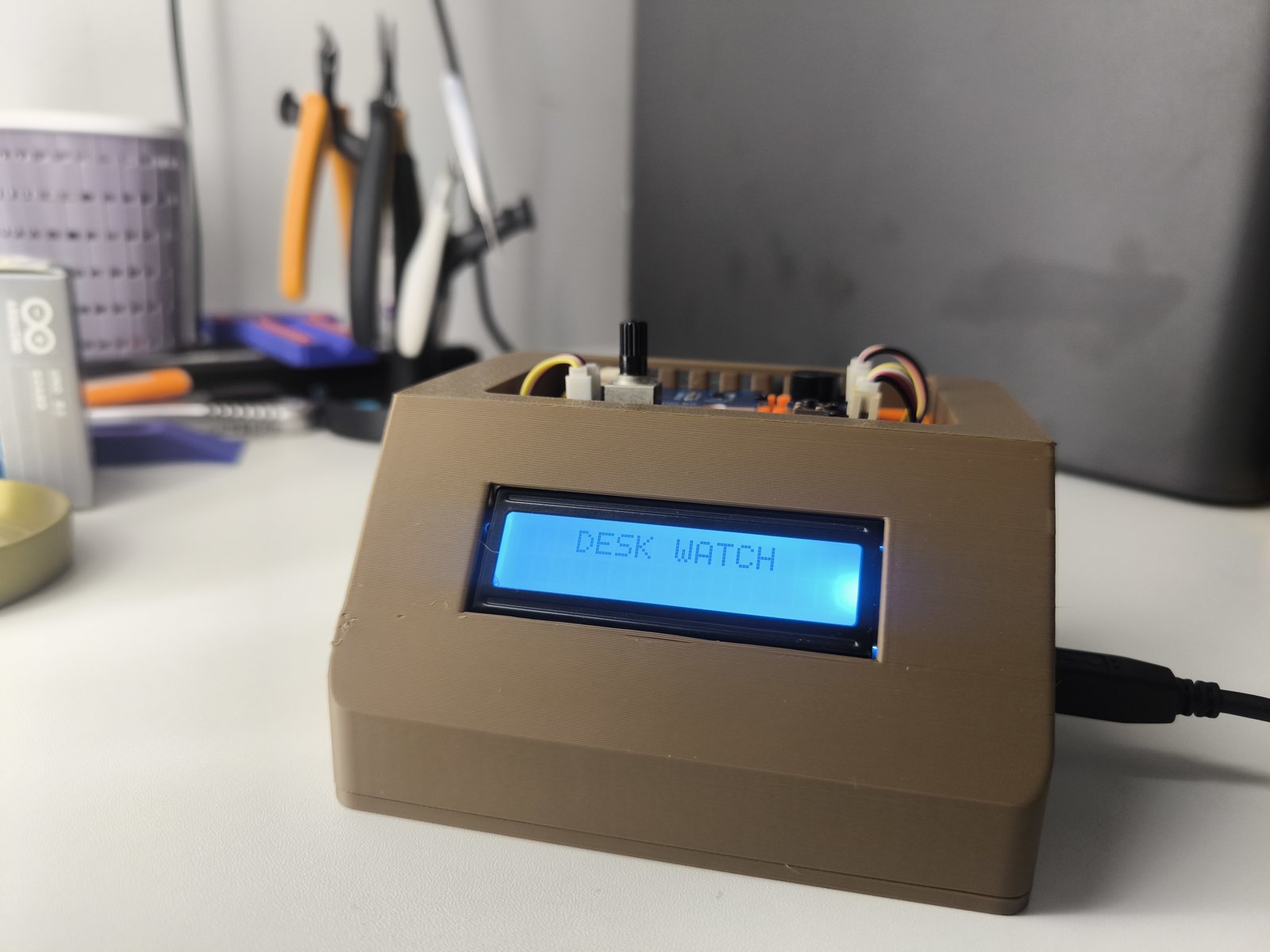
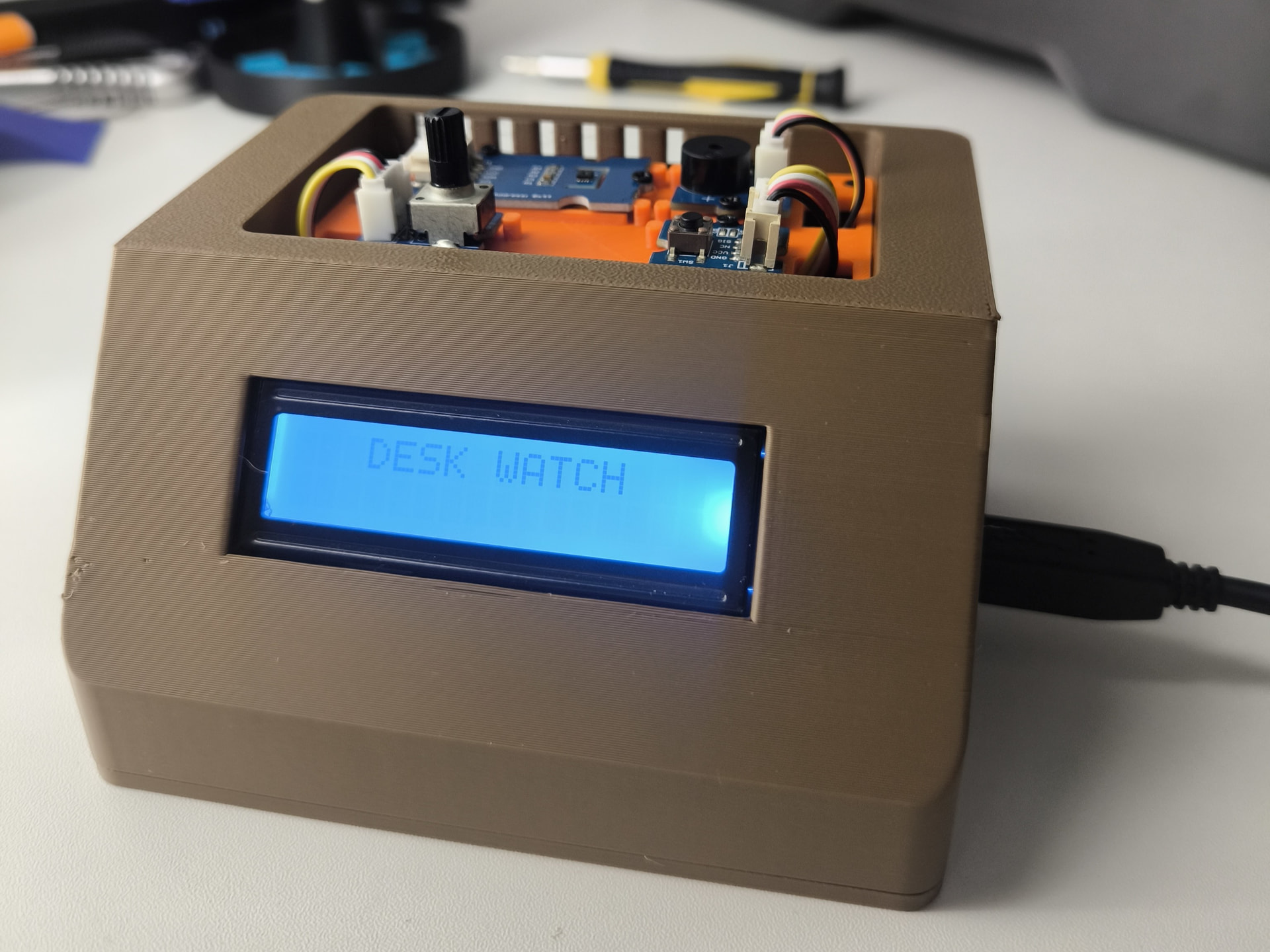
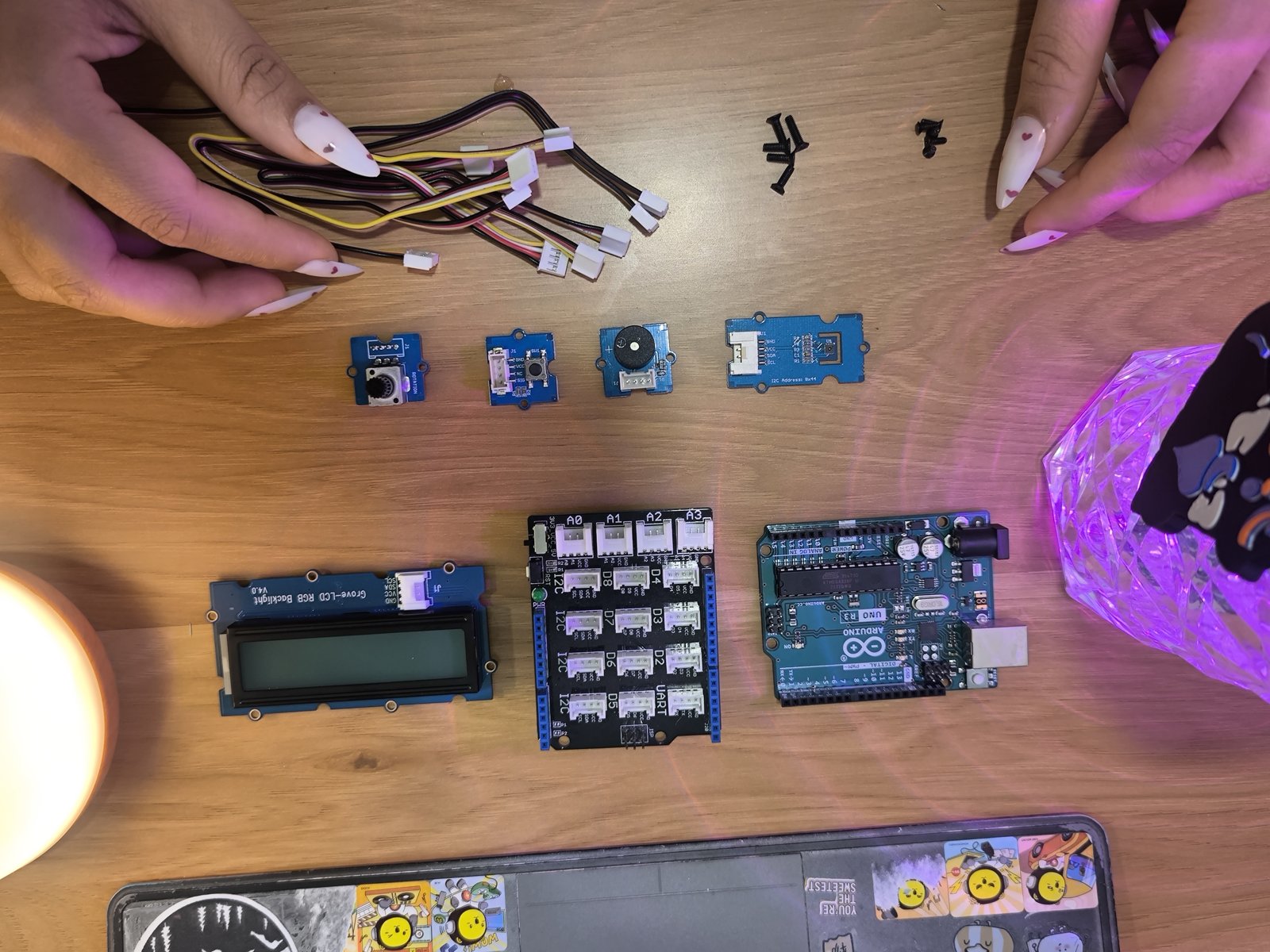
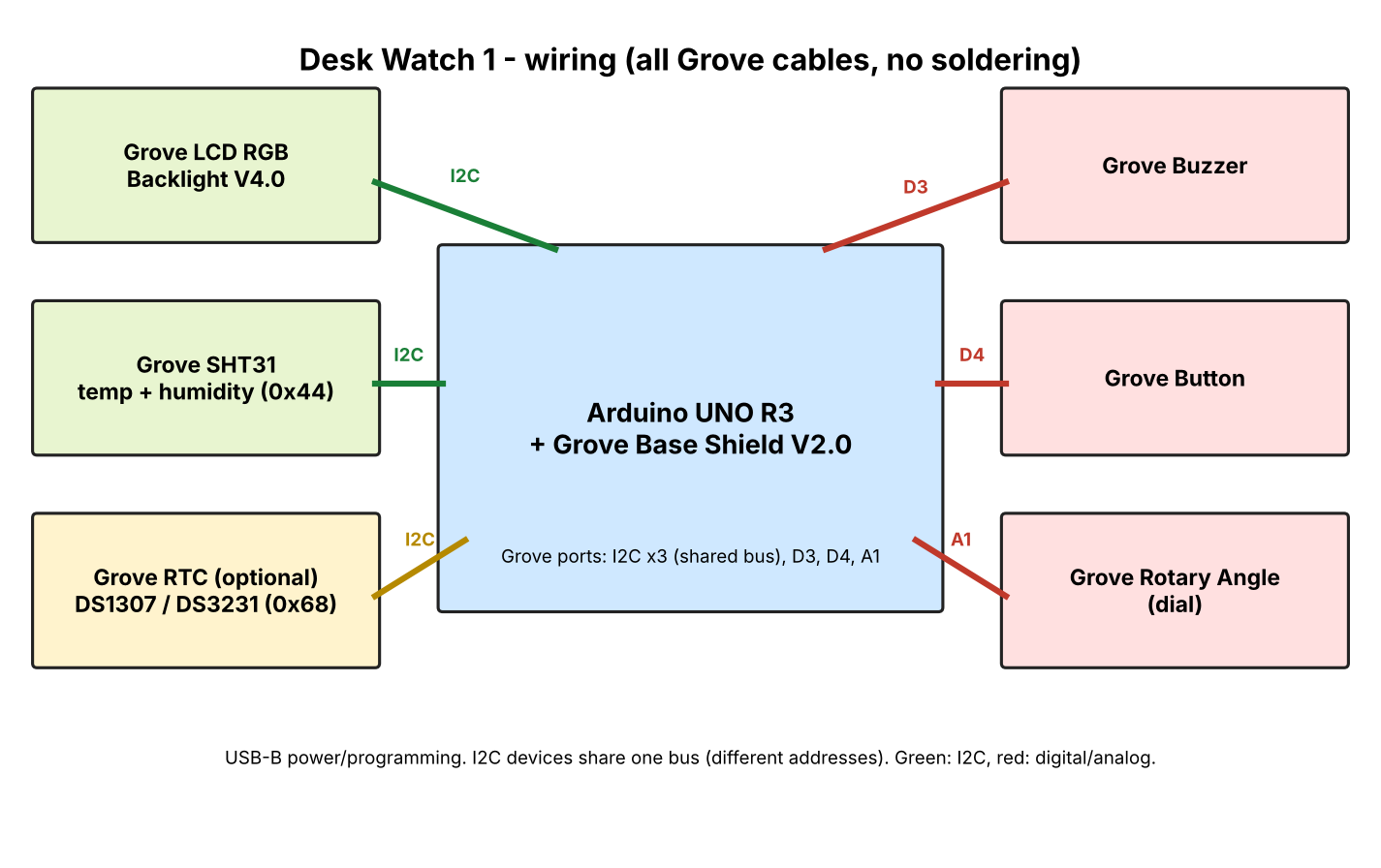
I would like to share Desk Watch, a small desk console built on an Arduino UNO R3 and the Grove system, with a 3D-printed case. Every module plugs in with a Grove cable, no soldering.
Grove SHT31 temperature and humidity sensor (I2C, address 0x44)
Grove Buzzer on D3, Grove Button on D4, Grove Rotary Angle Sensor on A1
Optional Grove RTC, DS1307 or DS3231 (I2C, address 0x68)
What it does
Temperature and humidity with adjustable high and low thresholds: the LCD backlight turns red, blue or green and the buzzer warns you
Pomodoro timer (1 minute to 4 hours), stopwatch and hand counter
Dice from D2 to D100 and a chess clock with 10 time controls
Melody player and alarm sounds, settings for brightness, volume, night mode and more
With the RTC module: clock on the home screen, alarm and automatic night mode
One button and one dial to navigate the menu
Two editions: MELODY (10 menu entries) and TEACHER (11 entries, adds an exam countdown that also counts the papers handed in). Each edition comes in a French build and an English build
Software
Install the “Grove - LCD RGB Backlight” library in the Arduino IDE, open one of the sketches in its matching folder and upload it. No other library is needed. The Arduino IDE reports about 74 % of the UNO flash for MELODY and about 80 % for TEACHER. The SHT31 readings are CRC-checked. The code is commented and released under GPL v3, so it can be read and changed.
Status
Earlier versions were tested on several Arduino UNO R3 boards; the latest firmware changes still need a physical check. The SHT40 is not verified: the firmware implements the SHT31 protocol.
I am a maths and technology teacher and I made it as a practical desk tool that is also a friendly electronics project for students. Feedback and suggestions are very welcome.
So , probably the coolest “GROVE” implementation I have seen to Date !
Great work, we should do more of theses, and Seeed should add more connectors to
stuff
I would like to see them adopt the smaller connector too like the Qwiic /Stemma QT
would be Great!
I agree: Grove makes it easy for students to build something that works without soldering, and a smaller connector like Qwiic / Stemma QT would be great for compact builds like this one.
Just one small note: there is no YouTube subscriber clock in this project. The apps are climate alerts, Pomodoro timer, stopwatch, counter, dice, chess clock, melodies and an alarm. Maybe you were thinking of another project?
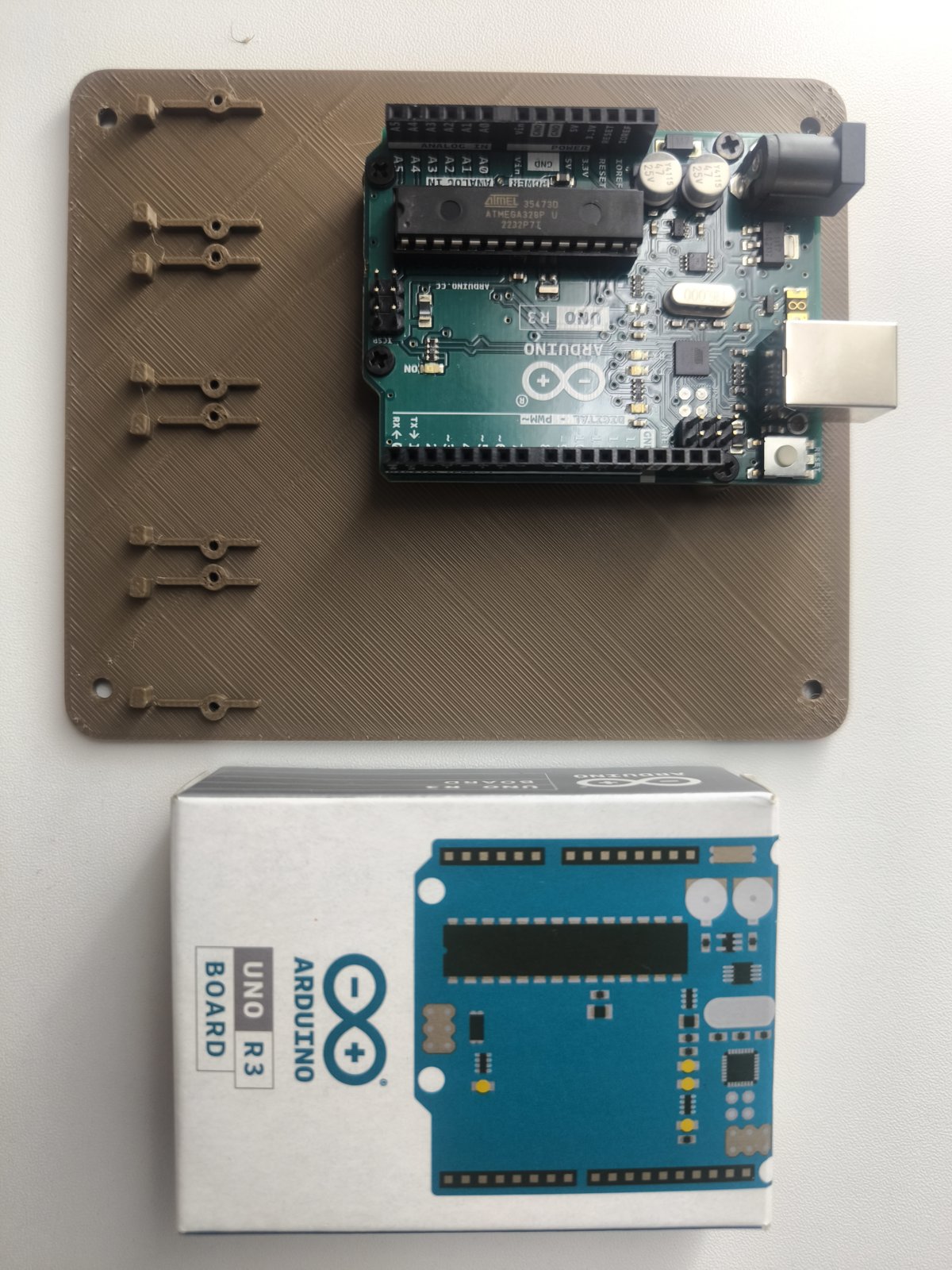
I am currently working on a joystick-based range for classroom use. The shell stays the same across the whole range, so you can try it with your own modules. What changes is the base and the tray, depending on each person’s configuration and needs. Feedback is very welcome.
Nice build. If you go to classroom batches like 20-30 units, count BOM cost per unit early. UNO + base shield + 5 Grove modules adds up fast. At some point one small carrier board with same parts is cheaper and still no soldering for students. Keep a few Grove ports on it so they can plug extra sensors.
I agree: Grove makes it easy for students to build something that works without soldering, and a smaller connector like Qwiic / Stemma QT would be great for compact builds like this one.
Just one small note: there is no YouTube subscriber clock in this project. The apps are climate alerts, Pomodoro timer, stopwatch, counter, dice, chess clock, melodies and an alarm. Maybe you were thinking of another project?
I am currently working on a joystick-based version for classroom use, so feedback is very welcome.
Thanks for the suggestion. I’ve already calculated the BOM cost. We’ve accumulated many Grove modules and Arduino UNO R3 boards over the years, and we’re now looking to move to the R4. This project is a chance to put our existing parts to good use and turn them into a good-looking, useful object for everyday use. I’ve also created several versions that share the same enclosure; only the tray changes to suit each configuration. Keeping the modules easy to access and swap is part of the idea.
Thanks! I can see the resemblance. The XIAO expansion board is a nice example of a compact, modular design. For this project, I’m using the Grove Base Shield V2.0, which is great because it lets me connect many Grove sensors and actuators at the same time. I’ve created several Desk Watch versions that share the same enclosure, with only the tray changing for each configuration. The goal is to make a good-looking object that’s useful in everyday life.



 PJ

